Librairie Antiquaire Emile Kerssemakers – Heerlen
Emile Kerssemakers – Antiquarian Books

Parcourez 29.855 livres anciens et d’occasion

Tri
Affichage
Phonology and Phonetics in Coatzospan Mixtec. — GERFEN, Chip

Phonology and Phonetics in Coatzospan Mixtec.

GERFEN, Chip
Kluwer Academic Publishers / Studies in Natural Language and Linguistic Theory. Volume 48
1999, viii,304pp, Hardcover. Good condition.
his book focuses on two major issues - vowel glottalization and nasalization - in the phonology and phonetics of Coatzospan Mixtec (henceforth CM). CM is an Otomanguean language currently spoken by roughly 2000 people (Small 1990) in the village of San Juan Coatzospan, which is located in the Sierra Mazateca of northern Oaxaca, Mexico.' Though Mixtec constitutes a major branch of the Otomanguean family, the so-called dialects are most appropriately viewed as distinct languages. According to Josserand (1982), there are at least 22 mutually unintelligible varieties of Mixtec. For its part, CM is among the most isolated. Located in the mountains, the village is surrounded entirely by Mazatec speaking communities. Only two other Mixtec languages exhibit over a 25% rate of mutual intelligibility with CM (Josserand 1982). And though it is not clear how this group of Mixtecs came to settle in what is a Mazatec speaking area, their isolation has given rise to special properties not shared by other varieties of the language. Major elements of both the phonology of vowel glottalization and nasalization under focus in this book are, to my knowledge, unique to CM among the Mixtec languages.
Fundamentalism & Freemasonry. The Southern Baptist Investigation of the Fraternal Order. — LEAZER, Gary

Fundamentalism & Freemasonry. The Southern Baptist Investigation of the Fraternal Order.

LEAZER, Gary
M. Evans and Company, Inc.
1985, 253pp, Cloth, with dustjacket. In good condition.
"What is fundamentalist Christianity? How did fundamentalists become the religious right? Why is this religious group so politically powerful? Why have they targeted Masons for special attack when so many fundamentalists are themselves Masons? A popular definition of a fundamentalist is an evangelical who is mad about something or someone. They have also been described as militant evangelicals who insist on doctrinal uniformity and lead or support attacks against what they define as liberal theology, liberal social issues and certain elements of modern science. In fact, fundamentalism as a mindset can be traced to 1860-1890 Princeton Theological Seminary conservatives concerned about preserving the fundamental concerns of the Christian faith in the face of the religious, scientific, technical, social, and intellectual trends of the nineteenth and twentieth centuries. It was not until 1920 that Curtis Lee Laws, Baptist editor of the Watchman-Examiner, used the term fundamentalism for the first time. Leazer describes the fundamentalist takeover of the Southern Baptist convention (the largest Protestant denomination in the United States) in the face of every freedom for which Baptists have historically stood, and he examines its subsequent investigation of - and crusade against - Freemasonry. Freemasonry, fundamentalists claim, is based on universalism; it is a religion that denies the doctrines of Christianity; it uses suspicious signs and symbols; and it denies the deity of Christ. These and other issues are discussed and refuted in Fundamentalism & Freemasonry. Leazer argues that Freemasonry is like any other human organization. Members come with various faith commitments. Most Masons are Christians; many are members of other faiths. Masons accept men from different faiths as friends, fellow citizens, brothers, and individuals for whom God loves and cares."
Draait de aarde om de hemel? De verhouding wetenschap-geloof, belicht aan de hand van eigentijdse Nederlandse en Vlaamse auteurs. — DIERICK, G.

Draait de aarde om de hemel? De verhouding wetenschap-geloof, belicht aan de hand van eigentijdse Nederlandse en Vlaamse auteurs.

DIERICK, G.
Damon
1998, 367pp, Paperback. In prima staat.(9055734527)
KDSC Scripta van het Katholiek Documentatie Centrum en het Katholiek Studiecentrum De aarde draait om de zon. Dat is enkele eeuwen geleden wetenschappelijk bewezen. Tegelijkertijd zijn gelovigen ervan overtuigd, dat alles op aarde om de hemel draait. Hoe is de verhouding tussen die twee opvattingen? Breder hoe verhouden wetenschap en geloof zich tot elkaar? Als concurrenten of zelfs vijanden? Als vreemden? Als gesprekspartners, vrienden of zelfs verwanten? Dit boek zoekt naar een antwoord op die vragen en biedt de lezers rijk materiaal voor hun eigen meningsvorming. Er komt een breed spectrum aan opvattingen ter sprake, waarin de verhouding wetenschapsgeloof achtereenvolgens de gestalten vertoont van conflict, onafhankelijkheid, dialoog en integratie. Daarbij wordt niet slechts duidelijker hoe de verhouding tussen wetenschap en geloof is, maar ook wat wetenschap en geloof zelf zijn. Het gaat hier om een oud probleem. Daarom wordt ook aandacht besteed aan de geschiedenis. Maar elke tijd heeft behoefte aan zijn eigen standpuntbepaling, omdat wetenschap en geloof steeds van gedaante veranderen. In dit boek wordt de kwestie, tegen de achtergrond van de internationale discussie, belicht aan de hand van eigentijdse Nederlandse en Vlaamse auteurs.
De president-commissaris. Regisseur van het toezicht. — HAMEL, Joost van, SIMONIS, Patrick, WIJK, Erik van Wijk

De president-commissaris. Regisseur van het toezicht.

HAMEL, Joost van, SIMONIS, Patrick, WIJK, Erik van Wijk
Kluwer
2003, 132 pp, Linnen gebonden met stofomslag. In prima staat. (9013007082)
"Dertien zeer ervaren president-commissarissen, met elkaar dé toezichthoudende macht van corporate Nederland, onthullen hun ervaringen en opvattingen over gewenste en minder gewenste ontwikkelingen op weg naar een professioneler corporate governance. Een kijkje in de keuken. Wat zijn de (on)mogelijkheden om werkelijk goed toezicht te houden? Hoe houd je vinger aan de pols, welke signalen wijzen erop dat het fout gaat, en hoe grijp je dan in? Wat beweegt deze mannen (!) om als ex-voorzitters van Raden van Bestuur nog zoveel verantwoordelijkheid en risico op imagoschade op zich te halen? De president-commissaris is een pleidooi voor een opwaardering van de feitelijke rol van de president-commissaris. De enige die écht zorgt voor continuïteit van bestuur en toezicht. De regievoerder achter de schermen. Vertrouwensman en spelbepaler. Gezagsdrager en coach. Spin in het web."
Arthurian poets. Introduced by James P. Carley. — ROBINSON, Edwin Arlington

Arthurian poets. Introduced by James P. Carley.

ROBINSON, Edwin Arlington
The Boydell Press
1990, 387pp. Paperback. In very good condition.
`Traditional yet original, realistic but not in the reductive sense, he is too good to be forgotten.' ROBERTSON DAVIES Robinson's Arthurian poems, published between 1917 and 1927, won him a Pulitzer prize and yet are almost unknown today. With his introspective New England style and quiet tone, he brilliantly catches the tension between reason and passion that drives the characters of the Arthurian stories these are modern lovers, with the philosophical and psychological concerns of the early 20th century. The sense of vision, and the feeling that the world of Arthur mirrors the fate of all mankind, binds the diverse characters together, and makes Robinson's poems essential reading for everyone interested in the Arthurian legend in the twentieth century.
The Story of Poetry: Volume one. English Poets and Poetry from Caedmon to Caxton. — SCHMIDT, Michael

The Story of Poetry: Volume one. English Poets and Poetry from Caedmon to Caxton.

SCHMIDT, Michael
Weidenfeld & Nicholson
2001, 496 pp, Hardcover, with dust jacket. In very good condition. Pakketzending.
"In this wonderfully entertaining and instructive book Michael Schmidt gives us a history of English poetry from its beginnings to 1500. The book divides into two halves - the first is a history of the poets' lives, the times during which they were writing, and an account of their works; and the second is an anthology of poetry from the first English poem by Caedmon, which can be dated to about 657AD, to Langland, Gower, Chaucer, Lydgate, Dunbar, and Hawes.;Schmidt shows how language and the poetic imagination are shaped by politics and history, and brilliantly describes the workings of Old and Middle English, using modernised texts to render it unintimidating to our modern ears. This is an invaluable book for all readers of poetry and students who will find no other competing volume available. This is the first book in a major four-volume project to provide the most comprehensive history of English poetry."
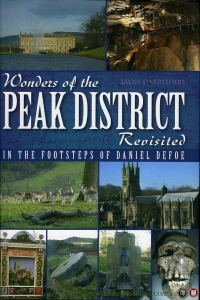
Wonders of the Peak District. Revisited. In the Footsteps of Daniel Defoe. — Darbyshire, Jayne

Wonders of the Peak District. Revisited. In the Footsteps of Daniel Defoe.

Darbyshire, Jayne
DB Publishing
2010, 192pp. Illustrated. Hardcover, with dustjacket. In very good condition.
"This is a book for the more discerning tourist (or the curious resident), who want to enrich their visit by delving deeper into the history and culture behind the places they visit or live close to. It provides a light, anecdotal dip into the history of each 'wonder', its associated legends and literary connections, as well as advice on features of particular interest for today's visitor in the area where each is located. This richly illustrated book quotes substantially from the writings of the famous novelist Daniel Defoe as well as earlier writers such as Charles Cotton and Thomas Hobbes. William Camden, author of Britannia (1586) wrote that Derbyshire was '...all rocky, full of barren mountains and wild'. The novelist Daniel Defoe called The Peak District a 'houling Wilderness.' Charles Cotton, writer, fisherman and resident of Derbyshire condemned it as 'A country so deformed, the Traveller Would Swear those parts Nature's Pudenda were.' Yet even before Cotton wrote his Wonders of the Peak (1681); generally regarded as the Peak District's first ever travel guide, tourists were flocking to the Peak District in huge numbers. So why did they come? What was the attraction? Landscape painters had yet to romanticise the beauty of the scenery and there were equally grand and awe inspiring wildernesses elsewhere. But the secret of the Peak's attraction to these early visitors lay not in its beauty, but in its reputation. In an age fascinated by mystery and steeped in superstition, the seven wonders, excluding perhaps Chatsworth, had been identified as sites of strange, mysterious and sometimes sinister goings on. Inexplicable vents of wind were said to issue from holes in the ground, springs ebbed and flowed for no apparent reason and caves lead to the centre of the Earth where resided the Devil himself. Visitors came in search of wild sensational experiences, to be terrified out of their wits and go home with a tale to tell. Daniel Defoe did much to debunk these tales of wonder 'The wit that has been spent on this Vault or Cave in the Earth, has been well enough to raise the expectation of Strangers, and bring Fools a great way to creep into it; but it is ill bestowed...' he complained of Poole's Cavern in his A Tour through the whole Island of Great Britain (1724-1726). But despite his scepticism about the many tales associated with 'the wonders', his writings provide a fascinating insight into the Peak District at this time. This book invites the reader to follow in mind or body, the journey taken by Defoe and other writers who visited the Peak District hundreds of year ago. At the site of each 'wonder', they are invited to explore through the evidence left by these early writers Peak local history, folklore and the legends and outlook of these earlier times. Updates are provided on what each wonder and the area where it is located has to offer today's visitor."
Women in the Poetry of T.S. Eliot. A Psychoanalytic Approach. — PINKNEY, Tony

Women in the Poetry of T.S. Eliot. A Psychoanalytic Approach.

PINKNEY, Tony
The MacMillan Press
1984, xii,156pp. Cloth with dustjacket. In good condition.
Contents 1). Theoretical preliminaries Klein, Winnicott and psychoanalytic aesthetics. 2). Wrestlings with the devil of the stairs early poems to 'Prufrock'. 3). Carving Hulme, Pound, Stokes and Sweeney. 4). Not waving but drowning 'The waste land' to Eliot's drama. 5). Stiffening in conclusions 'Gerontion' and the 'Objective Correlative'. With preface, notes and index.
Page 258 sur 467